✦ Pricing

Validation and Research

How to Research App Competitors Before Building Your iOS App

Compare competitors across positioning, search visibility, screenshots, ratings, reviews, update cadence and keyword gaps to find underserved intent.
Published Sep 17, 20265 min read
By AppStoreStatistics Editorial TeamReviewed by Tobias Krenn on Aug 22, 2026
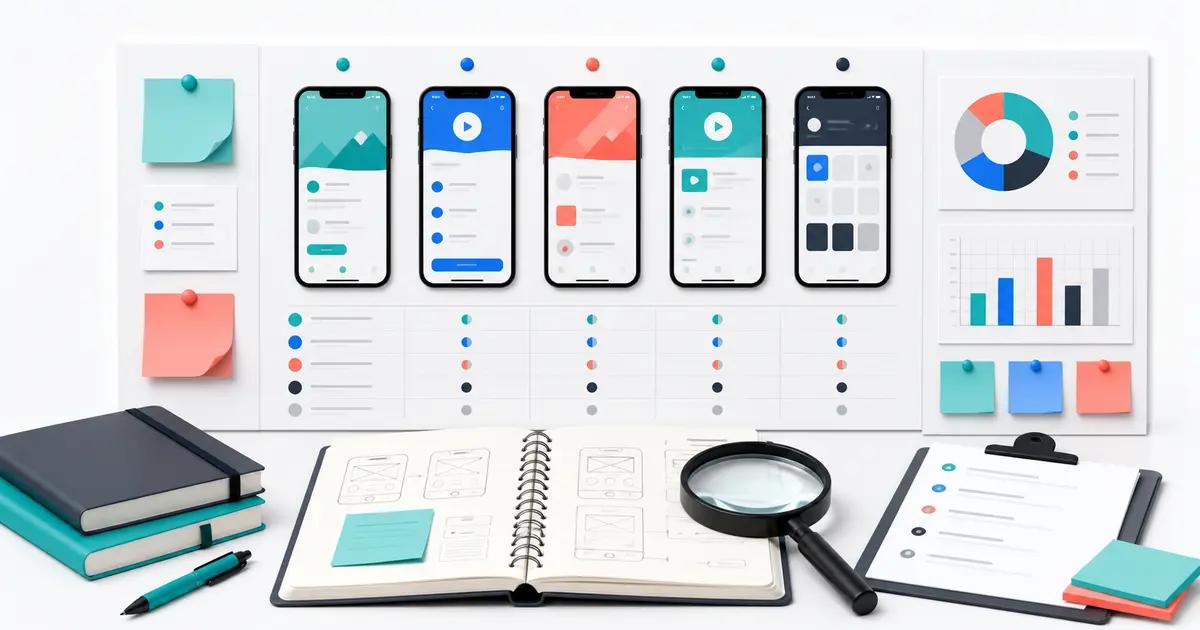
How to Research App Competitors Before Building Your iOS App editorial guide
In this guide

The central idea: Build a competitor research matrix based on positioning, metadata, screenshots, ratings, reviews, keyword visibility, update cadence and category performance.

Key facts

  • Apple says 70% of App Store visitors use search to discover apps and almost 65% of downloads happen directly after a search; that discovery context matters for “how to research competitors before building an app.”

Primary references checked for “how to research competitors before building an app” include Apple App Store Search, Apple Ads — App Store discovery/search statistics, Apple App Store ecosystem 2025 report.

Build a competitor map, not a feature spreadsheet

Feature comparisons tend to converge on “everyone has the same features.” A useful competitor map includes who the app targets, the promise in the first screenshot, the vocabulary used in title/subtitle, visible search positions, rating/review pressure, update cadence and repeated complaints.

Separate direct competitors from substitutes. A habit tracker competes with other habit trackers, but it may also compete with calendar workflows, spreadsheets or doing nothing. Those substitutes reveal different positioning opportunities.

The goal is to find where user intent exists but the current result set is weak, not to recreate the market leader.

Step-by-step: How to Research App Competitors Before Building Your iOS App

1. Record the top 10 results for each important keyword.

For “how to research competitors before building an app,” use the U.S. storefront consistently and save the exact query, date and result set. Relevance is the first filter; after that, compare brand strength, ratings and result quality to judge whether the term is realistically contestable.

2. Compare rating volume and recent review themes.

For this competitors workflow, reproduce the flow from a clean install with no developer-only assumptions. If a reviewer needs a credential, special state or explanation, provide it directly in App Review Information and verify that the credential still works.

3. Track how competitors describe outcomes in screenshots.

When working on “how to research competitors before building an app,” treat the listing as part of the product funnel. The promise in the title/subtitle and first screenshots should match the first-use experience. A higher rank for a mismatched promise can actually create worse conversion and retention.

4. Look for keyword gaps, not just feature gaps.

For “how to research competitors before building an app,” use the U.S. storefront consistently and save the exact query, date and result set. Relevance is the first filter; after that, compare brand strength, ratings and result quality to judge whether the term is realistically contestable.

What to measure

Metric / evidenceQuestion it answers
Keyword overlapWhere do both apps appear?
Review-gap themesWhat do users repeatedly complain about?
Creative positioningWhat promise appears in the first assets?

Common mistakes

  • Copying a competitor's keywords blindly. Confirm the bottleneck with a relevant baseline before acting.
  • Comparing only features. Confirm the bottleneck with a relevant baseline before acting.
  • Ignoring update cadence and reviews. Confirm the bottleneck with a relevant baseline before acting.
  • Researching one storefront and generalizing globally. Confirm the bottleneck with a relevant baseline before acting.

Execution plan

PhaseAction
Day 1Choose 5 direct and 3 adjacent competitors.
Day 2Capture metadata, screenshots, ratings and update cadence.
Day 3Map keyword overlap and review complaints.
Day 4Write three differentiated opportunities with evidence.

Frequently asked questions

Can App Store data prove an idea will succeed?

No. It can reduce uncertainty by showing competition, search behavior proxies, reviews and category patterns, but product quality, pricing, retention and execution still matter.

What should I research first?

Start with the exact user problem, then examine the apps and search terms that already serve that problem in the U.S. storefront.

How many competitors should I analyze?

At least several direct and adjacent alternatives. A single category leader is not representative of the market a new indie app must beat.

Should I trust estimated downloads or revenue as exact numbers?

No. Treat third-party estimates as modeled signals unless they come from your own authorized App Store Connect data. AppStoreStatistics explicitly labels modeled values rather than presenting them as official Apple figures.

Sources and review standard

Platform-specific claims are linked to primary documentation where available. AppStoreStatistics public data is observed or modeled as labeled; it is not private App Store Connect data.

Read methodology